
Sunday April 10 – Palm Sunday
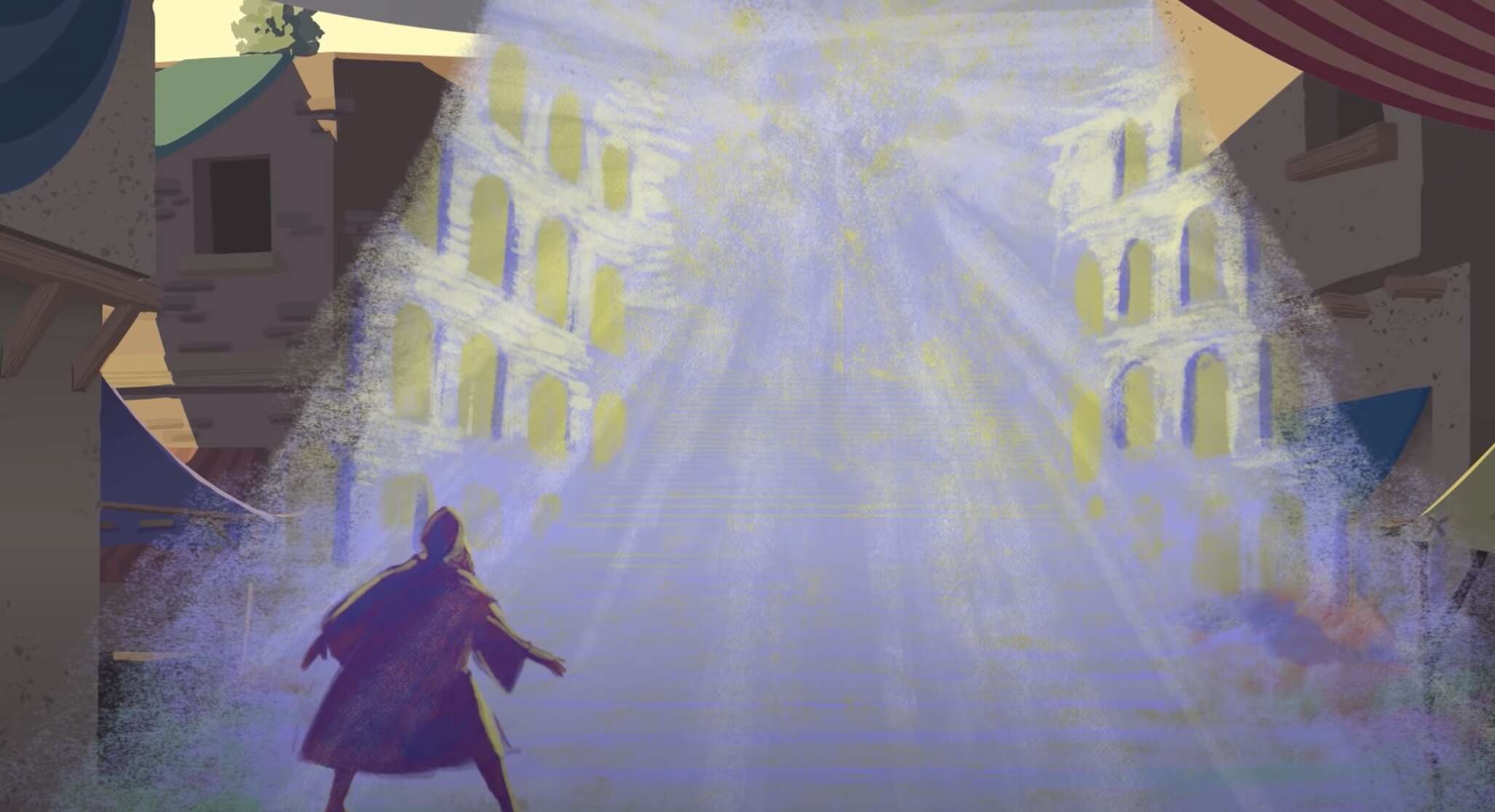
When we read all four accounts of Jesus’ life with a careful eye, we see that Jesus moves around a lot — all those scenes in The Chosen that happen on roads seem pretty accurate! All four accounts (Matthew, Mark, Luke, and John) describe with great detail Jesus’ final trip to Jerusalem, about a week before Passover. Within the week, Jesus’ trip to Jerusalem would turn tragic. While there are hints that Jesus knew how his last Passover would end, the people in Jerusalem are either completely in the dark (Matthew 21:10), celebrate him as a prophet (Matthew 21:11), or miracle worker worthy of being named king (Luke 19:37-38). The disciples seem bewildered (John 12:16).
Jesus had won the hearts of many people who were excited to find out that Jesus would be celebrating Passover in Jerusalem just like them. And they caused quite the scene, laying their cloaks in front of a donkey (ewww!) and waving palm branches (hence why we call this coming Sunday Palm Sunday). This was not unfamiliar, as there are passages in the Bible that describe the custom of worshippers waving branches as they or a revered object or person move through the city streets towards the temple (Psalm 118:19-29).
But instead of arriving at the temple to worship with his people and give thanks to God, Jesus makes a sharp departure from “business as usual” in Jerusalem. Upon arriving at the temple with celebratory shouts he condemns what had become of the temple — it was no longer a house of prayer but an economic machine, especially at Passover (the Jewish version of “Christmas and Easter” for modern church budgets?) He also does not deny the claims of the people, who with their shouts of “Hosanna to the son of Daivd” and “Blessed is the king” indicate their support for Jesus as their literal king (Luke 19:39). Jesus’ actions were understandably offensive to many — who is this untrained man from Galilee full of words, but not a sword? (a pre-requisite for king, right?) Those with the power to actually make him king react with anger, and resolve to make sure it never happens on their watch, even if it requires collusion with less-than-honorable allies.
This is the stuff of Victorian-era gossip! Would Jesus maintain his fame, or would he say or do something that would ruin him? Would his jealous onlookers find a way to accelerate his ruin? Would the people still support him when his name has been dragged through the mud?
Jesus does not defend himself the way most of us would, by engaging “peace talks” with his accusers. He spends the week in Jerusalem, much of it at the temple, teaching about the kingdom that his disciples are hoping Jesus will rule. From a human perspective, it is self-sabotage. In his last days, Jesus does not scheme to avoid death but is devoted to preparing his followers to understand his significance. Every day he teaches and answers questions while offending the very people who could preserve his life. He doesn’t care a bit what others think of him. He has a message he believes cannot wait for a “safer” time.
Maybe this says something about the urgency Christians should feel about sharing their faith, but in this moment I see a God that pursues his people even at risk to his own reputation and life. God does not consider the prayers of the pastors and missionaries as more important than the groans of the alcoholic at rock bottom, the exhausted mom who falls asleep after a minute of prayer, the cries (and curses?) of a father who just put his family on a train out of Ukraine. In fact, he will leave 99 of the former to go after just one of the latter (Luke 15).
Jesus spends the week walking through the streets of God’s beloved city, resting in the gardens outside the city, and moving among walls and shadows of the temple. It is in one of these moments that Jesus is moved to teach about what would become of the city and leave his listeners, many of whom would live to see the events he speaks about, with comfort and courage to face the difficult times ahead.
And that brings us to the text that we will read together on Sunday. In Luke 21 (also Matthew 24 and Mark 13) Jesus teaches about the “signs of the times,” many that sound all too familiar right now, as war continues in Ukraine. I have prepared a few videos (total 20-25 minutes) to stimulate your thinking.
If you haven’t visited us before, please know we have enough food, and our regular attenders will notice you and make you feel welcome. You are free to observe or participate — it is wholly up to you, we won’t call on you. If you have questions about visiting, please e-mail Pastor Christina at newvisionbic@gmail.com.
Smell: Read Psalm 24.
Taste: Watch the Videos
Our conversation on Sunday will take some turns, but I hope these videos will give us all some “hooks” to consider Jesus’ gracious message to us as recorded in Luke 21. Hint: Jesus’ message isn’t “when/how will the world end? and even though two videos have “rapture” in the title, I don’t want to have a long debate about a rapture except as it relates to Luke 21. I hope our conversation will be more about how Jesus wants to encourage his church going through extreme suffering. Let’s not wait until war comes to our land to have this conversation. Hope to see you Sunday for more!
Watch at home or at come to church early, at 4:15 pm, to watch before our gathering.
Video #1: How to read Apocalyptic Literature from the Bible Project (6:57). This isn’t about Luke 21 directly, but what we read in Luke 21 has a few things in common with what is called “apocalyptic” literature in the Bible (like Daniel 7 and the book of Revelation).
Video #2: Ben Witherington on the Rapture (5:14). In Luke 21 Jesus describes himself “the Son of Man coming on a cloud” which is very similar to what Paul describes about the coming of the Lord in 1 Thessalonians 4:16-18. This video unpacks that image a bit more. He will talk about something called an “entrance liturgy.” A liturgy is a prescripted order of actions, often for weighty events, like funerals, weddings, and worship services. In Jesus’ day there would have been “liturgies” for a king entering a city and for worshippers parading to the temple.
Video #3: N.T. Wright on the Rapture (5:30). This is very similar to the previous video, so it can be skipped. If you want to explore a little more what NT Wright is saying, look at Exodus 19:16-20 and 23:20-22, Daniel 7:13-14.
Video #4: NT Wright on the Second Coming (7:58). One of the debates about Luke 21 is whether it is talking about the end of the world (like the very end), or the destruction of Jerusalem that happened in 70 AD. NT Wright in this video talks a bit about the “son of man” image. Hold this question as you watch: What is the temple? A building or a person? And Where do heaven and earth come together?
Eat: Join the Conversation
In person: We gather Sundays at 5 PM. We eat a meal together, followed by a time of conversation and encouragement. No one will call on you. No need to bring anything, but if you are more comfortable with a contribution bring chips, bread, or a side dish. We hope to make you feel welcome! For more about what to expect, click here.
On Zoom: To join us for the conversation log on to Zoom around 5:40: click here for the link.
